Timeline - what we know to date
Nunhead appears in the Domesday Book, but despite this early reference, the area remains mostly rural for centuries, with little development beyond scattered homes and farmland.
During the Victorian period the character of Nunhead changes rapidly. Its proximity to London, the presence of the famous cemetery, and the arrival of the railway all contribute to orchards and fields being replaced by streets of terraced houses, creating a growing need for local schooling.
The introduction of the national elementary school system and the establishment of the School Board for London pave the way for formalised public education. This marks the beginning of plans to build schools in expanding areas like Nunhead.
Compulsory education brings renewed urgency to provide schooling for local families. Although two private schools exist, the Board identifies the need for a purpose-built elementary school to serve the large number of children living on the newly built Waverley Estate.
Ivydale Road Elementary School opens in temporary iron buildings near the current site, initially with 53 pupils. Enrolment doubles within weeks. The school operates as two departments—one for boys and one for girls and infants—reflecting common practice of the time.
With the national introduction of free schooling, demand continues to rise. The temporary structures quickly become insufficient, prompting the decision to construct a permanent school building to properly serve local families.
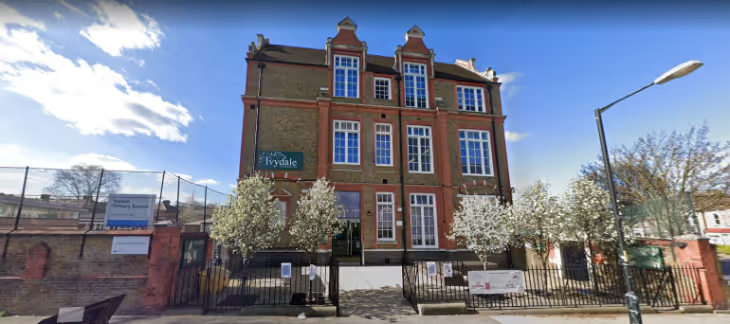
The new three-storey Ivydale school building is completed in August and officially opened in October at a cost of £30,000. Additional facilities are added soon after, including a laundry room for the girls’ department and a Manual Training Centre for the boys. School life is busy and structured, with large class sizes—one teacher famously manages a class of 74—and inspectors regularly praise the quality of work. Boys are taken on educational visits such as trips to Bethnal Green Museum and the Tower of London, although there is no evidence of similar outings for the girls. The curriculum focuses on strong English skills, scripture, and “object lessons” that blend science, geography, and nature. Infants learn through play, juniors move beyond the basics to subjects like history and geography, and practical skills are taught according to gender norms of the time.
The school undergoes reorganisation into three departments—boys, girls, and infants—each with its own headteacher. Children typically attend from ages five to fourteen, though the attic-floor “babies class” likely includes younger children.
Ivydale is again reorganised, this time into infant, junior, and senior departments, each led by its own headteacher. However, this structure lasts only briefly. When the Second World War breaks out in September, the school closes and its pupils are evacuated for safety.
Ivydale reopens during the war, welcoming returning children and resuming its role at the heart of the Nunhead community.